

New Seattle Mayor Katie Wilson talks homelessness, police tensions and World Cup countdown

One-on-one with Seattle Mayor Katie Wilson
In her first week as Seattle mayor, Katie Wilson pushed back on claims of changes to drug enforcement policy, saying no shifts have been made and calling recent confusion a result of misinformation. In a one-on-one interview with FOX 13, Wilson discussed working with police, prosecutors and service providers to address open-air drug use, public safety concerns ahead of the World Cup, and broader challenges facing the city.
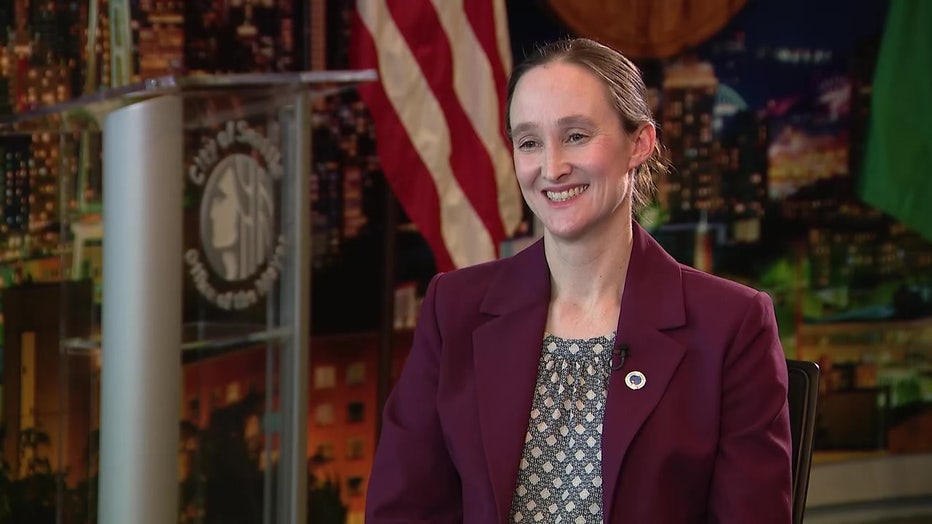
SEATTLE, Wash. - In her first week as Seattle Mayor, Katie Wilson sat down with FOX 13 to address questions regarding the enforcement of open air drug use in the city as well as several key topics regarding her term, including homelessness, affordability, World Cup and public safety issues.
In a one-one-one interview with Alejandra Guzman, she was excited to settle in and shape policy.
"It's exciting. It's great to be here," Mayor Wilson said. "We've got a great team, and we're rocking and rolling. I mean, things come at you every day, and here we are."
Guzman: "Day one, has anything come out, right out of the gates that you're kind of already tackling?"
Wilson: "Well, we had an interesting kerfuffle this morning around SPD, as I'm sure you're aware, not to bring that up, but you asked."
Guzman: "Since you brought it up. I don't know if we want to call it friction with Seattle police, but kind of walk me through what happened. I understand that there may be some conversations that you're having with top Seattle police leadership, whether that be SPOG (Seattle Police Officers Guild) or I don't know who is all involved, but are you thinking about any policy changes?"
Wilson: "No. So to me, this whole episode just kind of underscores how rumors work. So you know, there has been no policy change. We have discussed no policy change, and somehow, we woke up to the news this morning that we had made a policy change.
Guzman: "That was news to you, you probably saw this too, but Seattle Police Officers Guild President Mike Solan has already called this policy direction — that we know there's no change in policy here – 'suicidal empathy.' As a new mayor of the city, how do you plan to lead a police force where the union leadership seems to be openly hostile towards your platform?"
Wilson: "Well, you know, maybe Mike Solan and I need to sit down for a good talk."
Guzman: "Have you had any conversations with him since his postings?"
Wilson: "No, no, not since. I haven't. My people in my office, I'm not sure."
Guzman: "How are you feeling about this whole situation? I know you've since said, ‘if there's a policy change, you're going to hear from me directly.’ How are you taking in this news? How are you responding to some of the comments that he made?"
Wilson: "I mean, we're rolling with it, right? I mean, I think this is part of being a big city mayor, right? Things fly at you all the time, and, you know, in this case, it's, it's a misunderstanding, and we're going to move on, and we're going to focus on the work of leading the city and delivering results for the people of Seattle."
Guzman: "As you mentioned that there's no current policy change now. I don't know if there will be in the future, but I know that you previously mentioned that you're very excited to be working with the new current city attorney, Erika Evans, and she signaled that she's not going to enforce SODA/SOAP (Stay Out of Drug Areas/Stay out of Areas of Prostitution) zones. So, if open air drug use continues in the downtown core, what is Plan B to maintain public order before World Cup tourists arrive here in the city of Seattle?"
Wilson: "I think I don't want to speak for city attorney Evans, but I think what we've seen with the SOAP/SODA orders is that they're not necessarily the most effective way to address our drug hotspots. And so, you know, the areas downtown, 12th and Jackson, other areas in the city where we have open air drug use and, you know, related activity, those are going to be a very, very high priority for my administration, that we have to do better, right? And so there's a range of strategies. I mean, there's some work, good work already going on, but we're going to be working really closely with our police department, with service providers, with the LEAD program, to try to, first of all, prevent these drug hot spots before they form. But then we're going to be working really closely to make sure that we are as much as possible disrupting that activity and getting people the help that they need. So, yeah, I mean, you know, we have, we have good programs, and we're going to be doubling down making sure that those programs have the funding that they need, and that we're getting people the help that they need."
Guzman: "You've talked about tackling the homelessness crisis. This has been one of your promises from your early campaign days. I know that some residents feel that they have what they're calling ‘compassion fatigue.’ They want safety, but at the exact same time, they do want solutions. How do you plan on balancing accountability, treatment and public order?"
Wilson: "I mean, I think what we've seen in Seattle is that our rates of unsheltered homelessness are just unacceptable. So my administration is going to be moving aggressively to open new emergency housing and shelter and to get people inside with the support that they need. We know that a lot of our folks who are experiencing homelessness also have complex needs related to substance use disorder, mental illness, and we're going to be working really hard to get people inside."
Guzman: "This goes back to the 4,000 units that you initially promised as well. We are in a budget deficit. So I want to ask you, now that you're here in the mayor's office, where is the funding going to come from? And we've heard you say that you want to tax the rich, these large corporations, high earners. Is that how you plan on potentially funding it? Or we've also discussed looking at the budget and seeing what's working and what's not. Is there a feasible solution to this? And how soon are we talking about these 40,00 units becoming available?"
Wilson: "This begins with looking at the resources that we have and making sure that we're using our existing resources as effectively and efficiently as possible. My team is getting to work on that right now, and we're going to be scoping out sites potentially for new tiny house villages, micro modular housing, which is, you know, the kind of shelter that often unsheltered homeless folks are eager to move into. So we're doing that work now, and I think we'll have some more announcements and specific plans to share soon."
Guzman: "How do you measure success?"
Wilson: "I think ultimately you measure success by the number of people who are sleeping unsheltered on our streets going down."
Guzman: "Do we know what the current total is and what your goal is, maybe by the end of the first year? Or are we talking this is going to be your entire mayoral term that we're going to keep trying to decrease that number?"
Wilson: "There's no question that this is going to be a challenge that we are going to need to tackle throughout my entire first mayoral term. It's not something that you fix like that, right? The homelessness crisis has been a persistent and escalating problem in Seattle and King County for many years now. I mean, I remember back in 2015 when we first declared a civil state of emergency on homelessness. So this is not the kind of problem that you snap your fingers and solve it, but it's really going to take all of us pulling together. It's not even just a Seattle thing, right? Like we need to be working hand in glove with King County and Public Health, obviously, the King County Regional Homelessness Authority also with our business community, with service providers, with residents around the city. So, this is going to be a team effort, and I'm really hopeful that together, we're going to be able to make significant progress in reducing unsheltered homelessness. Over the next four years."
Guzman: "I want to talk a little bit about the FIFA World Cup. I know that you expressed some skepticism about big civic projects like the World Cup, you're now the mayor, and you're responsible for it being a successful event. With the eyes of the world on Seattle in just 157 days, right around the corner. How do you balance your ‘Bread and Roses’ philosophy with the massive security and the quote cleanup of the expectations of having such a global event like this in our city."
Wilson: "I mean, to be clear, I am very excited about the World Cup. I love soccer. I used to play soccer, and I just think this is going to be such a great experience for our city. So I am thrilled that we're going to be welcoming the world to Seattle. We're going to be able to show off our city. We're going to be able to have just this great diversity of folks from around the world all celebrating soccer, which, I mean, the reason why I love soccer is that it's such a universal sport, right? Like you just have a ball, a group of kids anywhere in the world can just set up goals and play the game. So, I think it's going to be great. Also, we need to be ready for it, right? So part of that is everything that we've been talking about, the homelessness crisis and public safety, and making sure that we're addressing those persistent issues, and not just, for example, sweeping people from downtown to other neighborhoods. So, we're going to be really, really focused on that. And also, we just want to make sure that the economic benefit of these games flows as broadly as possible around the city. Like, let's make sure that all the visitors to Seattle are visiting our different great neighborhoods, right spending their money at small businesses and really learning about the culture and history of our city, right? One of the wonderful things about Seattle is that we have all these different neighborhoods with different personalities and different communities, and so we really want to make sure that we're showcasing that, and that the people coming to visit are seeing that too, and not just like everything focused right around the stadium. We're going to be thinking about that, and we have just a great opportunity to think about how, like, what, what is the lasting impact that we want these games to have on our city, on our public space, on our transportation system. I'm going to be working closely with our Department of Transportation, other departments of the city, to make sure that we're making these improvements ahead of the games that can also last beyond the games for Seattle residents."
Guzman: "You've spent several years as a grassroots organizer, holding the mayor's office accountable is now something that you're responsible for. You're the mayor now. What is the single hardest compromise you've realized you've had to make to take on this role, or even this week?"
Wilson: "I think there's a couple things that are hard for me. One is just knowing that we're not going to be able to do everything that everyone wants us to do at the pace that people want to see that change, right? Like I'm coming into office with an ambitious agenda around, you know, both the issues we talked about, homelessness, public safety, also affordability, right? You know, people are really struggling with the high cost of housing, of childcare, of food and my administration is going to be doing everything we can to tackle that, because it's so important that the people who work in our city right, as a grocery workers, as baristas, janitors, can also afford to live here. So we're going to be tackling that, but just realizing what a big challenge that is and that we can't do it all at once, right? And we're going to have to prioritize. And so just knowing that, even as we push as hard as we can to make progress on all of these really challenging issues, like, you know, people are going to be disappointed that we can't move faster, that we can't do everything at once. So that, for me is hard, as someone who spent years pushing from the outside and being frustrated about, like, why isn't our government, just doing more, but at the same time, I'm very hopeful. I know that we can make really, really substantial progress. Another thing for me is, I've always been a very like, responsive person, right? Someone you know, emails me, calls me, I want to get right back to them. In the mayor's office like everyone you know, everyone is sending you requests, everyone is telling you what they think, and so we're setting up the system so that we can, you know, try to be responsive, but it's a little overwhelming sometimes where you're like, I want to reply to every email individually, and I also know I just can't do that."
Guzman: "So now, knowing, now that you're on the ‘inside’, would you say you understand why city government isn't as fast, easy like a snap of a finger?"
Wilson: "I think I've always had some realism about that, but I do think we can do better, right? Like I ran for this office, because I believe that people have a very low level of trust in government right now, across the board, nationally, locally, right? I just really believe that one of the most important things that I can do right now as mayor, is to do everything I can to restore that trust in our local government, to restore that trust that the government is working for you, is focused on getting results, is actually trying to make improvements in your daily life, whether that's to your commute or to your sense of safety in your neighborhood, or to your cost of living, and so I really believe we can do much better than we've been doing, and that's the whole reason I'm here."
Guzman: "When we talk about federal conflict, we're talking about potential shifts in federal immigration and funding policies. How much of Seattle's general fund are you willing to risk to maintain ‘Sanctuary City’ status if the federal government does threaten to withhold any grants?"
Wilson: "We're Seattle, right? We stand by our values. We protect immigrant communities, so we're not going to compromise on our welcoming city status, right? And at the same time, we need to have a plan in place and make sure that we're also protecting Seattle residents from the impact of potential funding cuts. And so that's something that my administration is taking very seriously, and that's a partnership, right? That's a partnership with the county, with the state, and making sure that we have the funds that we need here locally to preserve basic services and to provide people with the support that they need."
Guzman: "Circling back, I want to make sure I ask this properly in regards to treatment. Are we going to support mandatory treatment or shelter in certain cases, or should these services remain voluntary?"
Wilson: "This is a really complex question, and part of this is really a state level question around our laws around involuntary commitment. So that's a conversation that the city can be involved in, but doesn't have direct control over. What I'll say is that there's a lot of things that we need to do right and one is making sure that we are investing more in high quality treatment options. Many, many people, there's a moment where they want to go into treatment and then that's not there for them. Or you go into a treatment program, and then you come out the other end of that program and you don't have housing, you don't have shelter, and you're right back where you started. This is part of what I was talking about before, about making sure that our systems align and that we're investing in the services that people need. So that's a part of it. I think, when we think about our drug crisis, you know, we also have successful evidence-based diversion programs here in Seattle. This is not just a totally voluntary thing where you're going up to someone and you're saying, ‘Do you want treatment?’ Right? This is like someone who is struggling with substance use disorder, often is engaged in other illegal activities that are kind of related to that, right? And so there is a kind of a law enforcement, police part of this response, where you might arrest someone, or you might tell someone while you're going to get arrested if you continue to engage in this behavior. But then there's another pathway which is diverting someone into services, right? This is an approach which has been proven to be successful, because we also know that if you just arrest someone and you dump them in jail, and then they're out a few days later, right? Like that's also, that's not successful, that's harmful for them and ultimately harmful for all of us. So it's really about figuring out the approaches that work and then doubling down on making sure that we're sufficiently resourcing those approaches."
Guzman: "Has your plan or goal for the first 100 days changed?"
Wilson: "So we are still in the middle of our transition team process. So we launched a transit transition team in December, and this is a team of about 60 people who are community leaders, experts in their fields, and what they're doing right now is talking with a much wider circle of advisors around the city to help basically flesh out my campaign promises and priorities into actionable actions and policies for my administration, right? And so that process is going to continue through January. Of course, we're not waiting for that process to complete. We're hard at work on a number of issues already. I know that first 100 days is how everyone likes to think of everything, but we're not really focused on that period of time per se. What I will say is that I think the most important thing that I can accomplish in those first 100 days is building a stellar team that is going to be the foundation for everything we can accomplish in the next four years. So we're already well, on our way to doing that, we're almost totally staffed up in the mayor's office, and I'm just really excited about the team that we've assembled, and also just doing that work of improving the functioning of our city government in terms of the relationship between the mayor's office and all the city departments. There's so much kind of under-the-hood stuff which really impacts how the city is able to or fails to deliver results for people. What we learned stepping into this role, what my team learned, is just how much dysfunction there's been at City Hall for a long time, and so we're doing a lot of that, like behind the scenes, invisible work of making sure that we have the system set up and the communication so that we're really able to deliver for people."
Guzman: "Can you shed some light on that dysfunctional situation that's been happening for years?"
Wilson: "I think we've had a string of one-term mayors in Seattle, and you know what I'm trying to achieve is a real partnership between the mayor's office and our city departments, right? We have so many dedicated public servants, you know, working at the city, and I want to create a situation where city employees, city department leadership, coming to work every day, really feeling like we are pulling together toward a common vision. We see the problems. We're here to tackle them and that's just something I think, that hasn't existed for a while, right? Like there needs to be that sense of morale and being engaged in a common project, and so that's something that we're trying to cultivate."
Guzman: "I don't want to get ahead of myself, but if four years from now, affordability hasn't improved, homelessness hasn't declined, and childcare is still out of reach, should voters consider your term as a failure?"
Wilson: "You'll have to ask the voters. I mean, I think what I'll say is that, first of all, I believe that we're going to make progress, and at the same time like these are big, gnarly issues that are not 100% or even, you know, 50% or 25% sometimes in the control of the mayor of the city, right? So there are a lot of factors outside of our control that are going to influence our success on those issues, right? If there's a massive recession, and tons of people are, you know, tossed out of work that's not something that we can prevent, but it is something that we can pull together as a city to respond to in the best way we can, right? I mean, obviously I'm going to be judged on results. I expect to be judged on results. It's right that I'm judged on results, but the most important thing for me is that to create kind of this different attitude toward the city, where we're really bringing residents in, we're bringing the community in, and we are all in this together. So we see that, we see the issues, we're coming up together with the solutions that you know, the ways that we're tackling those issues. There's going to be challenges. In some respects, we will fall short. But I really want the people of Seattle to feel like we're engaged in this together and to and to be able to explain and have us all understand the challenges that we face, right, so that even if in some respects, due to factors outside of our control, we fall short on this goal or that goal, it's something that we all understand why, and we also understand what we need to do to go further, right? So to me, it's really like, that's really important, because we are all in this together, right? It's like, yeah, sure. I mean, voters will have a chance in four years to kind of decide how I've done and my administration has done, but, but I really think it is going to take all of us, and it's not just something that can be handed down from above."
MORE NEWS FROM FOX 13 SEATTLE
Major stretch of US 2 reopens in WA, lifting spirits for Skykomish businesses, residents
Police identify mother, son as 2 killed in Mercer Island murder-suicide investigation
New WA laws in 2026 include higher wages, luxury car tax, plastic bag fee hike
Seattle’s most anticipated new openings in 2026
WSDOT announces Revive I-5 work begins this January in Seattle
To get the best local news, weather and sports in Seattle for free, sign up for the daily FOX Seattle Newsletter.
Download the free FOX LOCAL app for mobile in the Apple App Store or Google Play Store for live Seattle news, top stories, weather updates and more local and national news.
The Source: Information in this story came from original FOX 13 Seattle reporting and interviews.