

Washington education ranking dips again in national report
Report: WA declining in children's education
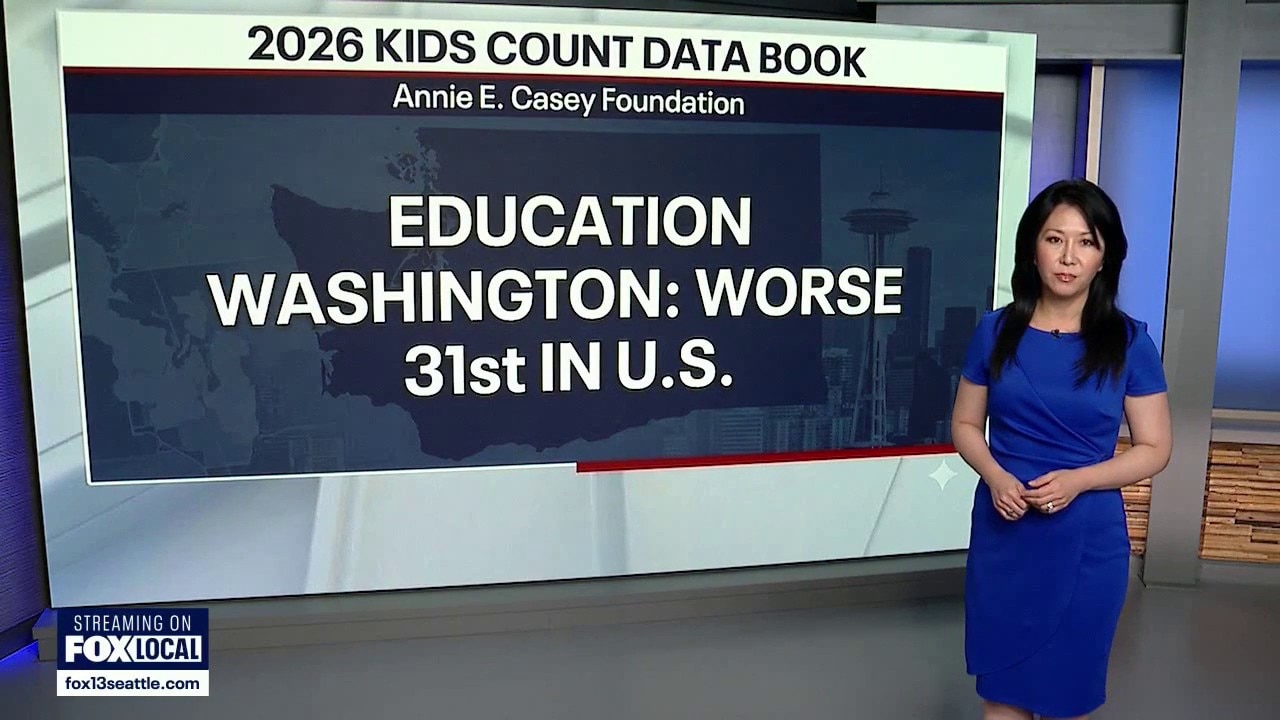
A recent report shows Washington is sliding in the wrong direction on a national education ranking. The 2026 Kids Count Data Book, published by the Annie E. Casey Foundation, shows that while Washington is improving in areas like economics and physical health, they are declining in education.
SEATTLE - While Washington improved its standing in overall child well-being, its public education system continues to slide in national rankings, according to a newly released report.
The 2026 Kids Count Data Book, published annually by the Annie E. Casey Foundation, ranked all the states in four different categories: of "best," "better," "worse" and "worst."
Washington ranked 17th in the nation for overall child well-being — placing the state in the report's "better" category due to decent metrics in areas like health, family and economics.
However, the state's education ranking painted a starkly different picture, landing Washington in the report's "worse" category. The state dropped to 31st in the nation for education, a four-spot decline from its 27th-place ranking in last year's report.
The data analyzed is from 2024. It shows the majority of Washington eighth graders do not meet the mark in math, with 70% not proficient.
On the reading metric of 4th graders showed 68% who are not proficient across the state.
WA still recovering from the COVID-19 pandemic
Dr. Soleil Boyd, Executive Director of the Children's Alliance — the state’s partner on the Kids Count report — attributed the educational slide to lingering pandemic recovery challenges and an inability to adapt to a changing student population.
"I think a lot of this has to do with our ability to recover from the pandemic, and then I think a lot of it has to do with our state's ability to respond to ongoing change," Boyd said. "We have an increasingly diverse set of students in our state, and we have to be able to meet the needs of all students in all places."
Boyd noted that even where improvements have occurred, they are not shared equally. "We see that while there are some modest improvements, they're not being made across student groups in the same way," she said, adding that "rural students continue to need greater support" and "students with disabilities continue to need greater support."
The Office of Superintendent of Public Instruction (OSPI), led by State Superintendent Chris Reykdal, pushed back against the ranking's methodology while acknowledging room for growth. In a statement, OSPI argued that focusing strictly on pre-pandemic baselines misses the current trajectory.
"Test scores in Washington have been trending upwards since they hit a low point during the pandemic, which occurred across the globe," OSPI's statement read. "A more sophisticated analysis of how our students are doing would measure a recovery since that drop instead of comparing scores pre-pandemic to post-pandemic."
OSPI also pointed out that when comparing test scores, Washington students performed on par with or better than peers in 11 other states that use the same test vendor. Specifically, OSPI highlighted Washington’s ranking of second-highest in English language arts and fourth-highest in math among those comparable states.
WA's state wealth does not equate to test scores
Boyd acknowledged the state's resource advantages but maintained that meeting local benchmarks is what truly matters.
"I think that's valid in a comparison across states to say we are doing better than many," Boyd said. "We are very, in many ways, a wealthy state, right? We have a lot of resources here […] What is also true is we're not meeting our own standards."
She added that despite minor gains, the state is falling short of broad proficiency. "We still do not have most of our students at grade level in math or English," Boyd said. "And so while the improvement is there, the overall expectation that every student reach grade level proficiency and reach that standard is not the case. That is not a criticism per se. It is a fact."
OSPI also pointed to rising kindergarten readiness as a bright spot in early learning. While Boyd welcomed the general positive trend, she cautioned that the progress remains highly unequal.
"I'm glad to see that kindergarten readiness has improved in general," Boyd said, but noted that "if we break that score down and look across geographic, demographic, and disability status areas, we know that that's not true for everyone."
According to Boyd, systemic access barriers continue to hold early childhood education back in Washington, where "almost about 57% of the kids" still lack access to high-quality early care and education.
"I think we can see that maybe some improvements have been made in a concentration of students that kind of pull up an average," Boyd said. "But what we're really needing to look at is each group of kids, how are they faring when they enter into kindergarten? We continue to see that there's not an equitable kindergarten entrance."
MORE NEWS FROM FOX 13 SEATTLE
6-year-old Bellingham, WA boy dies from injuries after beach driftwood accident
Grandmother thwarts Pike Place kidnapping, Seattle police make arrest
'Transfer Fire' near Lake Chelan, WA hospital prompts evacuation notices
Here's where WA wildfires are currently burning
Seattle office vacancy crisis shifts tax burden onto homeowners
Thurston County, WA couple desperate to find dog after Rover sitter vanishes
Husband of pregnant wife killed in Seattle sues King County homeless authority
To get the best local news, weather and sports in Seattle for free, sign up for the daily FOX Seattle Newsletter.
Download the free FOX LOCAL app for mobile in the Apple App Store or Google Play Store for live Seattle news, top stories, weather updates and more local and national news.
The Source: Information in this story comes from original reporting by FOX 13 Seattle anchor Hana Kim.