

Longview, WA paper mill slapped with record $10M fine in fatal spill
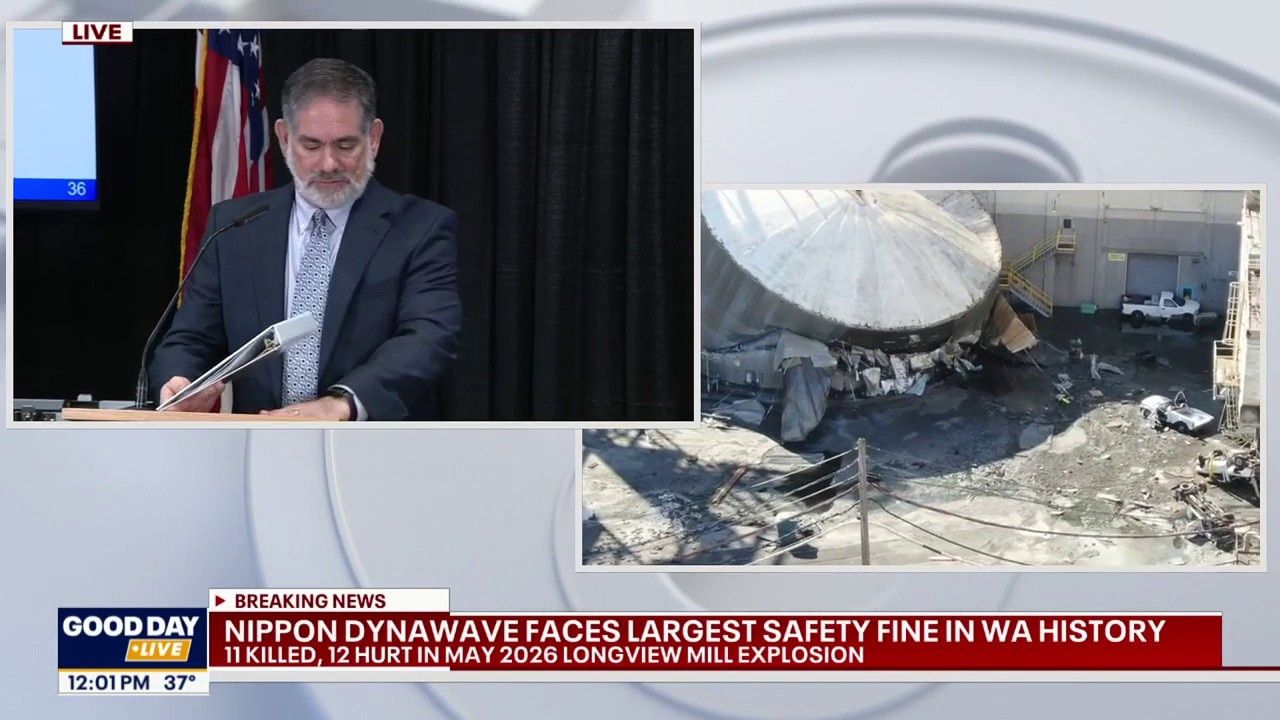
Press Conference: Nippon Dynawave Packaging faces largest safety fine in WA history
Nippon Dynawave Packaging, the Longview mill that faced a deadly tank implosion back in May, faces the largest safety fine—of just over $10M—in Washington history. 11 people were killed and 12 were injured. Here's a look at the full press conference led by investigators.
LONGVIEW, Wash. - Washington regulators fined Nippon Dynawave Packaging, the operator of a Longview paper mill, more than $10.1 million Friday, saying the company kept a "corroded chemical tank in service for 43 weeks after learning its walls were dangerously thin," until the tank ruptured in May and killed 11 workers.
The state Department of Labor & Industries cited Nippon Dynawave Packaging for 75 workplace safety violations and issued nearly $9.2 million in penalties, the largest workplace safety and health fine in the Washington agency’s history. The state Department of Ecology added nearly $1 million in environmental penalties and emergency response costs.
Keep reading to learn more about the fines and violations handed down to Nippon Dynawave Packaging and what happens next.
Big picture view:
Officials announced the update during a Friday press conference in Longview, adding that Labor & Industries will refer the case for potential criminal prosecution after investigators determined willful violations directly caused the workers’ deaths.
"Our findings are shocking and heartbreaking," said Joel Sacks, the agency’s director. "Nippon Dynawave had all the information they needed to act, but they didn’t listen to alarms their consultants and staff were raising."
The tank, known as G-tank, failed May 26 and released 900,000 gallons of white liquor, a caustic solution used in pulping wood, flooding the mill site. Twelve other workers were seriously injured, leading Labor and Industries to call it the "worst industrial disaster in modern state history."
The agency’s previous record fine, $2.9 million, followed the 2010 explosion at the Tesoro refinery in Anacortes. That explosion killed seven workers.
Nippon Dynawave Packaging knew the tank walls were ‘too thin’, investigators say
What they're saying:
Investigators found that Nippon Dynawave Packaging received three reports between August 2025 and February 2026 showing the tank’s walls had corroded well below the minimum safe thickness. Emails and internal documents show company officials discussed their options — repairing the tank, reducing how much liquid it held or taking it out of service — but did nothing, according to the agency.
Those options are spelled out in a national tank inspection standard published by the American Petroleum Institute, which Nippon Dynawave Packaging includes in its own internal procedures.
The six-month investigation included interviews with more than 70 witnesses and a review of more than 40,000 documents. It concluded that pressure from the liquid inside the tank exceeded the strength of its thinning walls, making failure inevitable.
Families were briefed privately ahead of the news conference
Jared Ammons was one of the victims in the incident. His widow, Mackenzie, said in a statement that "Nippon Dynawave took every opportunity to cut corners around safety and repair."
The WA agency issued 43 of the citations to Nippon Dynawave Packaging as "egregious willful serious violations," one for each week the tank stayed in operation unchanged after the first report. A willful violation means an employer knowingly failed to comply or showed plain indifference to safety rules. An egregious designation allows each instance of a violation to be counted separately.
The agency also found the company’s emergency planning and training fell short. For several hours after the rupture, there was effectively no company-led incident command separate from outside responders, the agency said, and the lack of preparation contributed directly to four additional injuries. Those failures accounted for 12 citations.
Another 20 citations involved the company’s failure to regularly inspect the interiors of 14 tanks, including G-tank, or to fix problems found during limited external inspections. Three tanks with known deficiencies were kept running without a required fitness-for-service evaluation, according to the agency.
What's next:
In its statement to FOX 13 Seattle, Nippon Dynawave Packaging disputed the state’s determination that its conduct was "egregious and willful," saying it did not include important facts and context about the timeline of events leading up to the May 26 rupture. The company did not specify what those facts were.
"We will address that issue through the appropriate appeals process," a company spokesperson said in an email.
The spokesperson said the workplace safety findings are separate from the question of what caused the tank to fail. L&I’s citations do not establish a root cause, which remains under investigation, the spokesperson said. L&I investigators concluded that pressure from the liquid inside the tank overwhelmed its thinning walls.
"We will continue to cooperate with the appropriate agencies. We believe the responsible course is to allow the full investigative process to proceed and establish a complete and accurate record before conclusions are reached," the spokesperson said.
The company has 15 days to appeal the L&I citation. Money collected from safety and health fines goes into the workers’ compensation supplemental pension fund, helping injured workers and the families of those who have died on the job.
Nippon Dynawave Packaging spill reached the Columbia River, killed fish
The Department of Ecology fined the Nippon Dynawave Packaging $296,500 for air, water and dangerous waste violations tied to the spill, and for deficiencies in plans and training found during a July inspection. The company must also pay $665,000 to reimburse Ecology and the state Military Department for emergency response costs in the weeks after the rupture.
The white liquor reached storm drains and the mill’s sanitary wastewater treatment system, and some of it bypassed treatment and flowed into the Columbia River, according to Ecology. Larger volumes reached a nearby ditch, killing large numbers of fish. The effects lasted a week or more.
"No penalty can begin to account for the loss of life in this tragedy," said Casey Sixkiller, director for the Department of Ecology. "However, this penalty addresses violations of air, water and dangerous waste regulations, and ensures that the responsible party reimburses the state’s costs for the emergency response that followed."
The Department of Ecology identified 34 violations, some lasting as long as eight days, though not every violation drew a penalty. State law allows fines of up to $10,000 per incident, per day.
This story will be updated as more information becomes available. Check back for updates.
The Source: Information for this story came from a press conference held in Longview, WA on November 20, 2026 and from Nippon Dynawave Packaging.
MORE NEWS FROM FOX 13 SEATTLE
Seattle bar owner defends controversial Ladies' Night email
Five Washington athletes back effort to keep girls sports initiative in place
Tacoma ICE detention center sold for $453M
Lynnwood drivers react to 24/7 school zone speed cameras proposal
Man charged in deadly shooting near Space Needle extradited to WA
To get the best local news, weather and sports in Seattle for free, sign up for the daily FOX Seattle Newsletter.
Download the free FOX LOCAL app for mobile in the Apple App Store or Google Play Store for live Seattle news, top stories, weather updates and more local and national news.