

WA researchers help solve scientific mystery that killed 5B sea stars

UW researchers help solve scientific mystery that killed 5 billion sea stars
A team of researchers, including some scientists from the University of Washington, has identified the bacteria responsible for a disease that has killed more than 5 billion sea stars along the North American Pacific coast over the past decade.
SEATTLE - A team of researchers, including some scientists from the University of Washington, has identified the bacteria responsible for a disease that has killed more than 5 billion sea stars along the North American Pacific coast over the past decade.
Keep reading to learn more about the bacteria discovery and what is being done about it.
What is Sea Star Wasting Disease?
What we know:
The disease, known as Sea Star Wasting Disease, has caused one of the largest marine wildlife epidemics in recorded history, according to Drew Harvell, an emeritus professor at Cornell University and an affiliate faculty member at the University of Washington.
"We’ve logged that as being one of the largest disease outbreaks of wildlife in the ocean," Harvell said.
(Hakai Institute)
The epidemic first appeared in 2013 and spread rapidly from Alaska to California, affecting up to 20 different species. The disease was so widespread that it was considered a pandemic, she said.
"The fact that it was multi-species, large numbers of stars and such a wide latitudinal range was really concerning," Harvell said.
The pathogen has been identified as a bacteria called Vibrio pectinis. The research was a four-year process led by Drs. Alyssa Game and Melanie Prentice, and was completed with the help of a graduate student at the University of Washington, Grace A. Crandall.
"It is the biggest marine disease outbreak of any species thus far in history," Crandall said. "And the 5 billion number, that’s just of the sunflower stars. There’s even more sea stars impacted."
What impact did the Sea Star Wasting Disease have on the ecosystem?
Dig deeper:
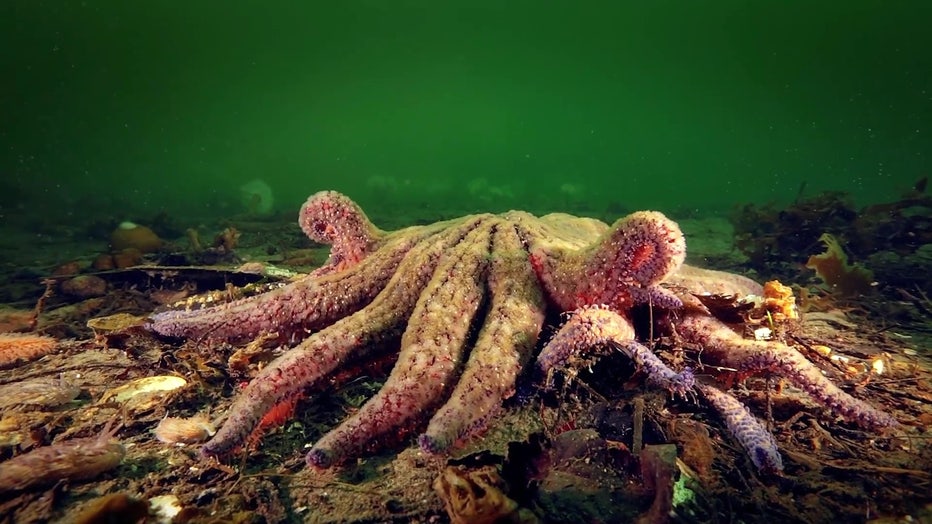
The sunflower star (Pycnopodia helianthoides), the largest sea star in the world, was particularly hard-hit and has been listed as critically endangered. It is a voracious predator that eats sea urchins. Its decline has led to an explosion in the urchin population, which in turn has caused damage to kelp forests.
"We now know they eat vast numbers of them," Harvell said of the sunflower star’s diet. "And so when the sunflower stars were removed, the sea urchins exploded. And sea urchins like to eat kelp, and so in a lot of places, particularly in California, where the loss of the sunflower star was so huge, the kelp beds have been demolished in some places by what we call urchin explosions."
(Hakai Institute)
In order to verify the pathogen, the researchers had to follow a set of steps called Koch’s postulates. This involved detecting the bacteria in sick sea stars, inoculating healthy stars with the bacteria, and then growing the bacteria in a lab culture to test on more healthy stars.
"It took a long time to get to that point, and then once we got to that point and followed the procedure, it worked out," Crandall said.
What are the symptoms of Sea Star Wasting Disease?
What they're saying:
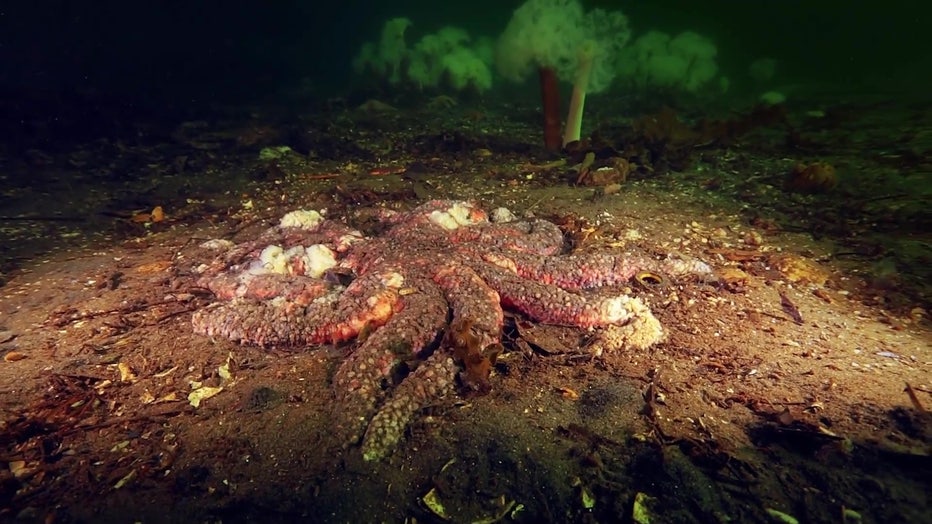
The disease causes a horrific physical breakdown in the sea stars.
"Their arms will literally detach from their bodies," Crandall said. She described how the arms will twist up and the sea stars will lose their internal pressure, appearing "a little like deflated." She said she has witnessed the arms and the body of a sea star walk in opposite directions.
"That’s kind of like, once we see that, there’s kind of, there’s been no turning back from that point," Crandall said.
The process of the disease is very fast, with death often occurring within two weeks of initial symptoms.
How can the sea star population recover?
What's next:
Now that the cause has been identified, the next steps include developing management strategies to help the sea star population recover.
"This research is a very big step for us to be able to develop better management protocols and approaches to hopefully get the disease in check, get these animals back in the ocean," Harvell said.
A program called "sunflower star recovery" is underway, with a captive breeding program based at Friday Harbor Labs and other aquariums on the West Coast.
Crandall is focusing her doctoral work on the immune responses of different species to see why some sea stars are resistant to the disease. The research could lead to the development of treatments like probiotics or antibiotics.
"There’s still so many unknowns," Crandall said, noting that they don’t know where the disease originated or if it affects other species. However, she believes the discovery is a huge first step.
"Now that this discovery is out, people can start working on this project more," Crandall said. "I’m really excited to just sort of watch and see what comes from here."
MORE NEWS FROM FOX 13 SEATTLE
Alaska Airlines to launch flights to London, Reykjavik from Seattle
PSE warns of power shutoffs as WA wildfires surge
Hundreds attend vigil for man shot, killed outside Seattle church
Titan disaster that killed 5 on way to Titanic was ‘preventable,’ Coast Guard says
Seattle Police Chief Shon Barnes addresses recent gun violence
To get the best local news, weather and sports in Seattle for free, sign up for the daily FOX Seattle Newsletter.
Download the free FOX LOCAL app for mobile in the Apple App Store or Google Play Store for live Seattle news, top stories, weather updates and more local and national news.
The Source: Information in this story came from an interview with University of Washington researchers.