

Blood Moon total lunar eclipse 2026: When, where you can see the astronomical phenomenon
Skywatchers across much of the world will have the chance to witness a total lunar eclipse in the early morning hours of March 3, when the Moon will glow red for nearly an hour.
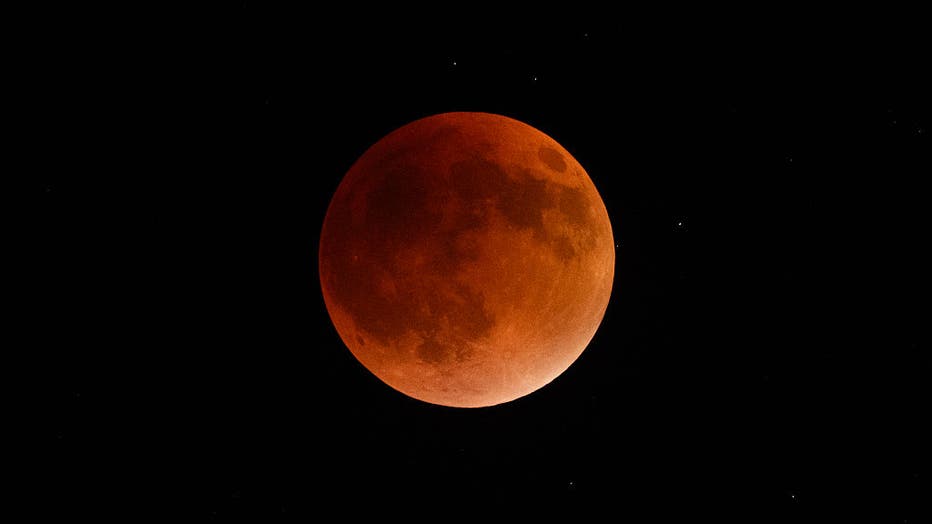
The total lunar eclipse reaches its peak in Sri Lanka, on September 7, 2025, with the Moon turning red during the totality phase. This ''blood moon'' phenomenon occurs when Earth's shadow completely covers the Moon and sunlight is refracted through E (Photo by Isura Nimantha/NurPhoto via Getty Images)
According to NASA, the total phase of the eclipse will be seen at different local times around the world: in the evening across eastern Asia and Australia, throughout the night in the Pacific, and in the early morning in North and Central America as well as the far western side of South America.
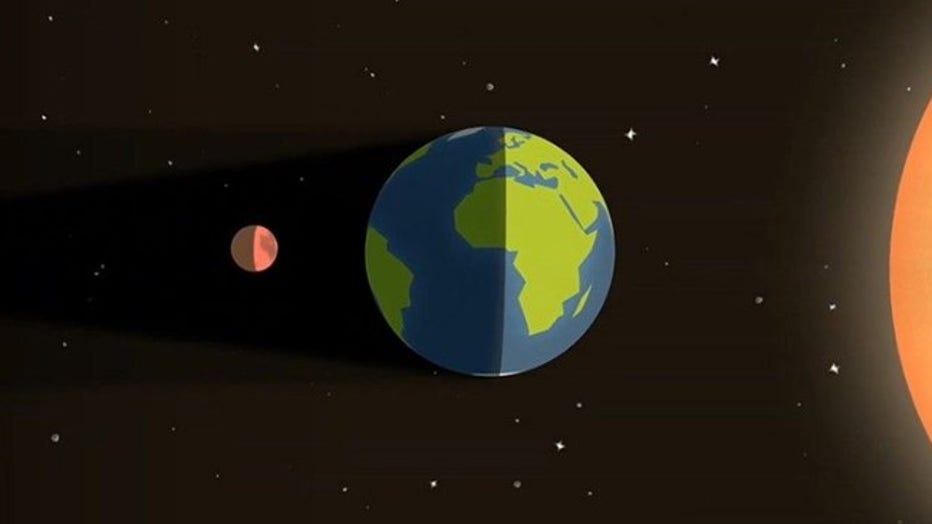
This image depicts the alignment of the Moon, Earth, and Sun during a lunar eclipse (not to scale) ((NASA's Scientific Visualization Studio / NASA))
During a lunar eclipse, Earth moves directly between the Sun and the Moon, causing the Moon to fall into Earth’s shadow and take on a reddish-orange hue; hence the name "Blood Moon".
This type of event can occur only during a full Moon.
How and when can I expect to see the lunar eclipse?
NASA said skywatchers won’t need any special equipment to observe the eclipse, just a straight-line sight of the moon, but "binoculars or a telescope can also enhance your view."
The totality of the eclipse will begin at 3:04 a.m. PST (6:04 a.m. EST, 11:04 UTC) and end at 4:03 a.m. PST (7:03 a.m. EST, 12:03 UTC).
And the entire lunar eclipse will conclude at 6:23 a.m. PST (9:23 a.m. EST, 14:23 UTC).
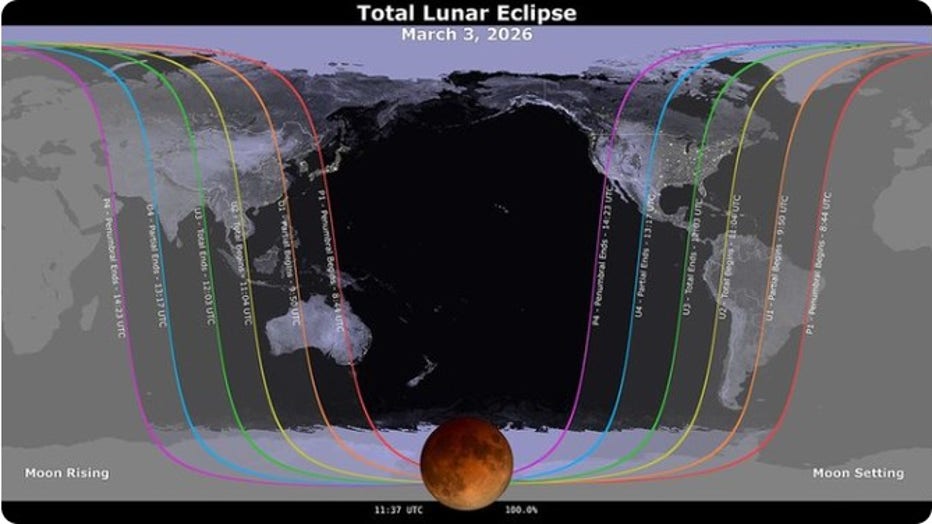
This map shows where the March 3, 2026, lunar eclipse is visible, with the contours marking the edge of the visibility region at eclipse contact times, labeled in UTC. ((NASA’s Scientific Visualization Studio / NASA))
NASA suggests if you're taking photos, "use a camera on a tripod with exposures of at least several seconds."
On the horizon, skywatchers can look forward to another event on March 8 – a conjunction of Venus and Saturn.
Will the lunar eclipse be visible in Seattle?
According to FOX 13 Seattle Meteorologist Ilona McCauley, unfortunately, cloudy skies in the Puget Sound region will make it unlikely that we'll see it.
The Source: Information in this story comes from FOX Weather and FOX 13 Meteorologist Ilona McCauley.
MORE TOP STORIES FROM FOX 13 SEATTLE
5 dead after stabbing, police shooting at WA home
WA leaders divided over Trump's State of the Union address
New report shows more Latinos without criminal histories being detained under Trump
Everett CEO says Trump tariff turmoil strains international competition
WA lawmakers review duplicate sign-ons on millionaires tax bill
Seattle unveils 2026 FIFA World Cup fan celebration sites
To get the best local news, weather and sports in Seattle for free, sign up for the daily FOX Seattle Newsletter.
Download the free FOX LOCAL app for mobile in the Apple App Store or Google Play Store for live Seattle news, top stories, weather updates and more local and national news.