

WA family shocked as murderer's life sentence reduced, released without notice

WA family shocked as murderer's life sentence reduced, released without notice
A man convicted to life in prison was able to walk out of prison a free man. The family of the victims learned of the man's release through a text message from the Department of Corrections.
KITSAP COUNTY, Wash. - Days before Thanksgiving 2024, Ginny Brideau received a text message that rocked her, and her family, to their core. The man that murdered her mother, a man that had been convicted of two life sentences, was walking out of prison a free man.
Gerald R. McCord, 51, and Connie Case, 42, were shot and killed at point-blank range inside their home while they slept in October 1994. The duo behind the killings, McCord’s own son, Steve McCord and nephew, Ernie Benson, made off with roughly $250 and some guns.

A picture from the early 1990s of Connie Case and her partner, Gerald McCord, prior to being murdered in 1994. (Ginny Brideau)
Roughly 30 years had passed when Brideau received the unexpected text message that the shooter, Benson, had been released from prison. It wasn’t even clear how that was possible, as the text was from the prison system, and unrelated to the court system that had made the ultimate decision to release him.
That was just the beginning of the ordeal, as the Kitsap County prosecutor appeared to have plans to resentence Steve McCord, the other convicted murderer, setting the stage for his own release from custody.
"We were done," said Brideau, wiping away tears outside the courtroom where she had just pleaded to keep Steve behind bars.
"This has caused everyone to have to reopen chapters that were done … to have to come back and revisit all of this when this was supposed to be done. It’s humiliating, it’s devastating."
A 2021 ruling in the Washington Supreme Court opened the door for Benson’s resentencing as it determined life sentences without parole for juvenile offenders was unconstitutional.
Resentencing plans spark outrage from victims’ families
Benson was two weeks shy of his 21st birthday when he shot and killed the couple inside their Silverdale home.
Brideau and her family would have been given the right to speak at his resentencing, but the Kitsap County Prosecuting Attorney’s Office failed to contact them. Making matters worse, the Kitsap County Prosecuting Attorney’s Office had also started conversations about a potential resentencing for Steve.
According to emails obtained by FOX 13 Seattle, the prosecuting attorney’s office had opened a dialogue about resentencing Steve, a move that would involve the prosecutor petitioning the court. Steve wasn’t entitled to resentencing, but prosecutors viewed it as an "equitable" move since Benson had just been released.
It wasn’t until Brideau and her family began flooding the Kitsap County Prosecutor’s Office with phone calls that they reversed their decision to seek resentencing.
"Flat out, we made a mistake with Mr. Benson," said Chad Enright, the Kitsap County prosecuting attorney.
"We have an obligation to notify the victims, the family of people who have been killed … and we took a 30-year-old case, old paper files, sticky notes, and we tried to contact who we could find; and we failed."
As Enright told FOX 13 Seattle, he realized his office had failed to contact a number of family members of the murder victims. Once it became clear the murders were still raw to the victims’ families, he made the decision not to petition the court for Steve's resentencing.
Unfortunately, for Brideau, the journey wasn't done. McCord is now petitioning the court for resentencing, kicking off a new court battle.
As Enright explained to FOX 13 Seattle, the case wouldn’t just free Steve if it swings in his favor, but it could change the state’s landscape by opening the door for other convicted murderers to be given constitutionally required resentencings.
What went wrong?
Dig deeper:
A 2021 Washington Supreme Court decision known as the Monschke decision opened the door for dozens of prisoners serving life sentences to pursue new sentences. The ruling found that life sentences with the possibility of parole for young offenders are cruel and unusual punishment, and thus unconstitutional.
Benson was required resentencing based on the ruling, but the Kitsap County prosecutor’s office failed to connect with the victim’s family members as the hearings unfolded.
According to Jason Ruyf, the deputy prosecutor working the case, only one person was tracked down: Benson’s sister, who was in support of his release.
In the three decades since the brutal killings, the county had undergone changes to digitize its old paper filing system. However, this case only used paper files. Enright told FOX 13 Seattle that he estimated there were at least 2,000 pages of documents, including police reports with handwritten notes, spread out across eight boxes.
"We had to have a legal assistant, a victim advocate, go through that file and try to find whatever information she could on the family," said Enright.
"People have moved out of state, names have changed, and at the time … 30 years ago … police reports and investigations were focused on the investigation, it’s not focused on who the children of the victims are."
The advocate who was in charge of contacting the family is no longer working with the Kitsap County Prosecuting Attorney’s Office, though the damage was done.
Making matters worse, was the way Brideau and her family received the news: through a text message.
As part of a Department of Corrections program, they received a text that Benson had been released from prison, sending panic throughout the entire family. The idea that he could be resentenced was never proposed, and given the abrupt nature of the revelation, they weren’t aware whether they could soon cross paths with him.
"We weren’t contacted," Enright said. "Nothing. [Benson] walked into court, walked out with a resentencing, and a few days later he was free on the street," said Brideau. "This is a man who killed two people … he killed my mother."
Enright admitted it was awful: "To have that news dropped on you via a text message, I mean … that’s a horrible way to get the news."
A second release?
The news didn’t get any better for the Brideau family.
Once they made contact with Enright’s office, it became apparent that they had planned to clear a path for Steve's release, as well.
A July 2024 email sent by deputy prosecutor Jason Ruyf explained that Enright was looking to invoke RCW 36.27.130 on Steve's behalf, a 2020 law that gives prosecutors the discretion to petition a court for resentencing.
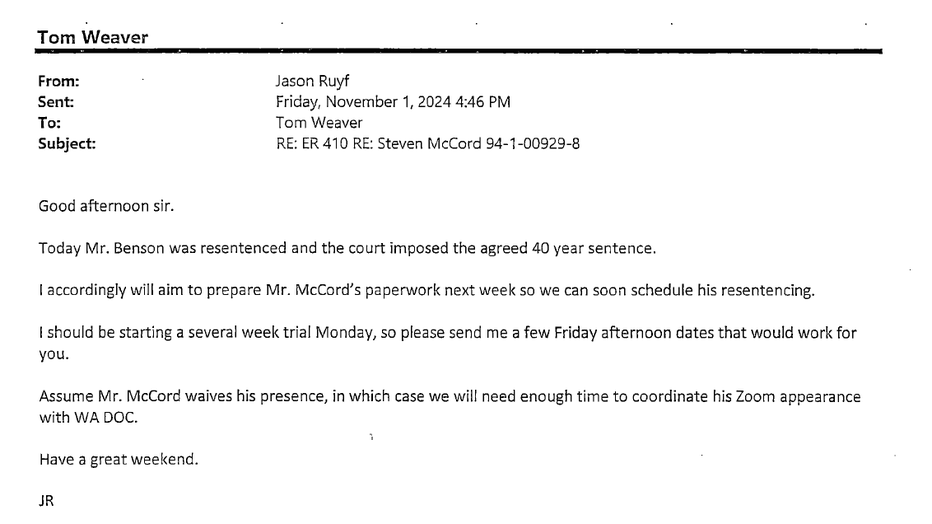
An email explaining the expectation to re-sentence McCord following Benson's release from prison.
Steve was roughly six months older than Benson when the murders occurred, meaning the Monschke decision did not apply. Emails, released in court filings, explained how the prosecutor believed using his discretion to extend a similar sentence to McCord was "the equitable thing to do."
Once it became clear that Brideau, and her extended family, were against the move, the prosecuting attorney changed its tune.
A hearing that had been slated for Feb. 7, where it was expected that Steve would be resentenced, was soon removed from the docket. Enright had a change of heart, but the move would lead to a 123-page filing by Steve's lawyer arguing that the Monschke decision should apply to his client.
A legal battle unfolding
Over the last several weeks, a legal battle has been unfolding inside the Kitsap Superior courthouse, with Brideau flying in from Los Angeles to stand side-by-side with roughly a dozen family members, many of whom still reside in Kitsap County.
McCord, now 51, attended court in early March via Zoom. He said little as he listened to lawyers argue, knowing his future likely lies between two fates with a gulf between them: freedom, much like Benson received, or the rest of his life behind bars as his original sentence called for.
"Being a victim is a lifelong sentence to itself," said Brideau, minutes after making an impassioned plea in court to keep McCord behind bars. "You have to now be responsible for knowing where the person who created this horrendous crime is every day."
Kitsap Superior Court Judge Kevin Hull considered the argument for a few weeks before returning a written ruling, ordering McCord’s motion for resentencing to be transferred to the state court of appeals.
A brutal killing for a few hundred dollars
Benson admitted that he was the one who opened fire on Case and Gerald in late October 1994. He also told investigators that Steve had talked about shooting his dad and Case, so he could pawn items from inside their home to get cash.
On Nov. 3, Benson conducted a taped interview with detectives stating Steve had obtained the .380 that was used in the murders from a vehicle, and that he used his own key to enter the home.
Benson entered the darkened bedroom where the couple was sleeping, shooting Case from what he estimated to be 1-and-a-half to 2-feet away. He then shot Gerald, but failed to kill him. He left the room when the gun jammed, telling investigators that Steve would help him unjam the gun as he listened to him struggle to breathe for several minutes.
"He told me his dad was still alive and to go back in there and to do it," said Benson.
Later adding, "I couldn’t stand to hear him suffer." Explaining further that Gerald was struggling, and choking on blood; Case was already dead.
The duo would later flee to Las Vegas before anyone discovered Gerald and Case had been murdered.
A total of four guns were stolen from the home, two of which were pawned for $150 dollars. Steve estimated they had stolen roughly $250 in cash. They also stole their cars, but would ditched one of them after engine trouble.
It only took a few days for the discovery of the bodies, and detectives to realize they were looking for Steve McCord.
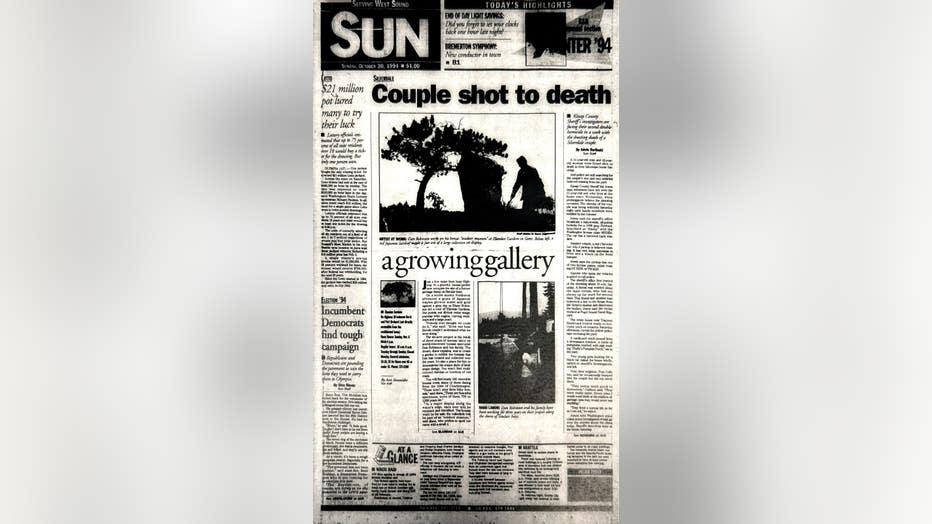
Kitsap Sun Headline: October 30, 1994
On Saturday morning, Kitsap County Sheriff Pat Jones was notified of the double homicide. The following day, the Bremerton Sun's front page read: "Couple shot to death," with details on the search for the couple’s son.
The potential of expanding the Monschke decision
The question surrounding whether Steve will receive a resentencing stretches beyond his own case.
Enright admitted that he’s fearful that the McCord case could land in the state's Supreme Court, with the potential of expanding the Monschke decision to people that were given life sentences beyond the current reading of the law.
As it stands now, life without the possibility of parole is considered cruel and unusual punishment for any offender aged 18 to 20 years old at the time of a crime. Benson was required resentencing for that reason.
The appeals court has previously held that standard.
In a recently unpublished decision titled "Matter of Sayasack," the court noted:
"The harsh reality is that no matter where the age limit is set, someone will always be just days away from having it apply to them."
The defendant in that case had turned 21 years old days prior to a crime, whereas Steve was five months beyond his 21st birthday.
Enright’s concern is over a simple narrative: McCord, while slightly older, committed the same crime as Benson, only one of them has received a resentencing.
"That may be a fact pattern that causes the supreme court to expand [Monschke] to 21 … and then we have a whole new group of victims across Washington that will be going through the same thing."
The Source: Information in this story came from the Kitsap County Prosecuting Attorney’s Office and FOX 13 Seattle original reporting.
MORE NEWS FROM FOX 13 SEATTLE
New US Marshals photos show high-stakes WA manhunt for Travis Decker
$79M Seattle-area home is now most expensive listing in Pacific Northwest
Seattle’s Duwamish River Festival canceled over concerns of ICE agents
Seattle to consider issuing $1k fines for illegal graffiti
Report states half a million WA drivers have expired tabs
To get the best local news, weather and sports in Seattle for free, sign up for the daily FOX Seattle Newsletter.
Download the free FOX LOCAL app for mobile in the Apple App Store or Google Play Store for live Seattle news, top stories, weather updates and more local and national news.