

Gov. Ferguson: How WA is adapting to federal healthcare changes
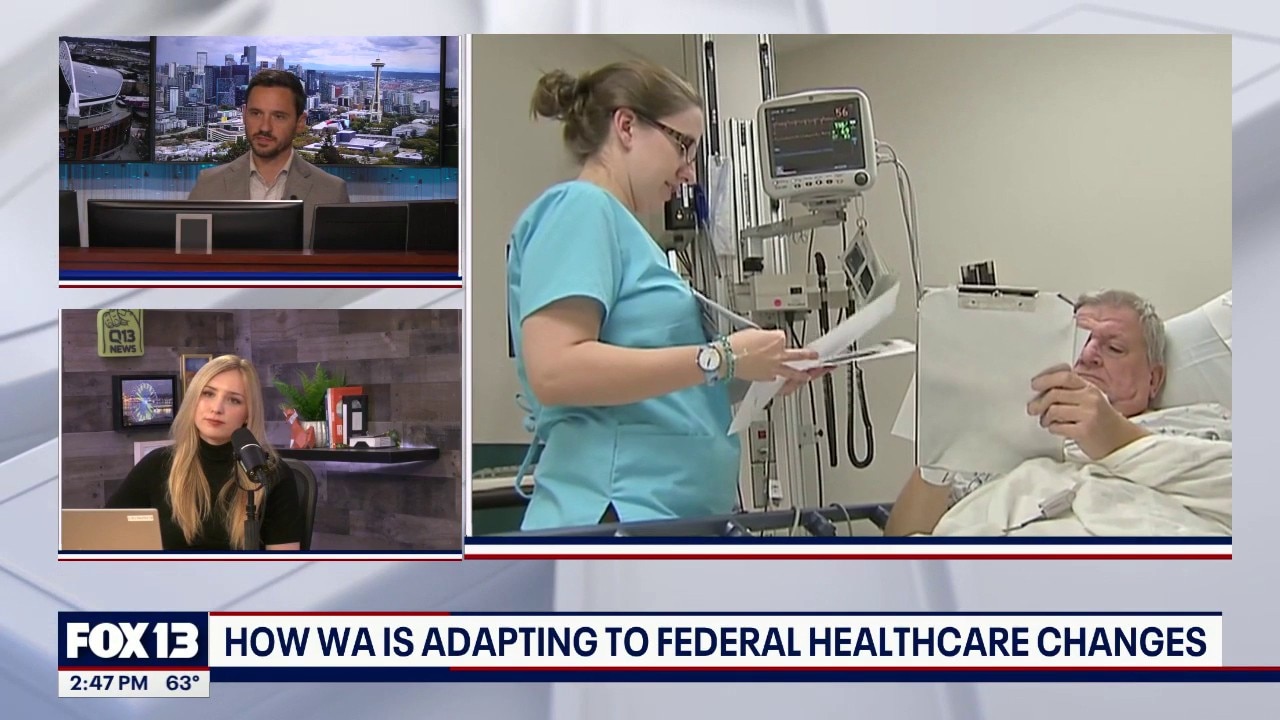
How WA is adapting to House Resolution 1's federal healthcare changes
WA officials held a press conference Thursday, outlining the next steps to adapt to healthcare and Medicaid changes required by House Resolution 1, or President Trump's 'One Big Beautiful Bill.'
SEATTLE - On July 4, 2025, President Donald Trump signed House Resolution 1 (H.R. 1), a major federal reconciliation and tax package.
More commonly referred to as the "One Big Beautiful Bill Act," H.R. 1 combines tax and financial provisions, immigration and border security along with healthcare and safety net changes, which directly affect the state of Washington.
Governor Bob Ferguson held a press conference Thursday alongside Health Care Authority Director Ryan Moran and WA's Insurance Commissioner Patty Kuderer, addressing how our state plans to efficiently adapt to and mitigate harm from new federal healthcare regulations.
Further, the governor signed an executive order at the press conference that outlined said mitigation efforts, established a new H.R. 1 response committee and directed a public awareness campaign to get the word out to impacted WA residents.
Keep reading to see where Medicaid recipients in WA are impacted and what you can do to ensure you are in the loop on the changes.
What is House Resolution 1?
H.R. 1 (enacted as the One Big Beautiful Bill Act / Working Families Tax Cut Legislation) is major federal budget reconciliation legislation signed into law by President Trump.
It enacts widespread tax, spending and welfare program overhauls, with its most notable provisions impacting Medicaid, food assistance, federal health subsidies and public benefits.
Big picture view:
In House Resolution 1, Subtitle B, Chapter 1, Medicaid is discussed, where it mandates a few things:
- Non-disabled, working-age adults on ACA Medicaid expansion must complete at least 80 hours per month of work, education, or community service to retain coverage.
- Medicaid expansion enrollees need to re-apply and verify eligibility every 6 months (twice a year) instead of annually.
- Certain categories of lawfully present immigrants (such as humanitarian asylees and refugees) are excluded from standard Medicaid coverage, limiting them primarily to emergency care.
- Enhanced federal premium tax credits are expired, leading to higher insurance premiums for individuals purchasing plans through state health exchanges.
- Federal health care cuts and food assistance spending nationwide, shifting a greater share of Medicaid and SNAP costs onto state budgets.
Timeline:
On Oct. 1, changes to the federal definition of "qualified immigrants" take effect. This is defined as a non-U.S. citizen who holds a specific authorized legal status, such as green card holders or political asylum seekers.
On Jan. 1, adult enrollees must begin verifying at least 80-hours-per-month of work, training or community engagement to keep coverage and will need to verify eligibility every 6 months, rather than annually.
What is WA doing to adapt to changes?
What they're saying:
Ferguson highlighted a few state mitigation achievements, announcing the targeted outreach to immigrant communities has already helped 3,000 lawful immigrants adjust their status to maintain coverage, which reduces the Oct. 1 impact to 11,000.
Further, our state is launching an automated verification hub to confirm eligibility automatically, which is expected to protect coverage for 400,000 residents.
Ferguson said our state is leading the nation in building the automated verification hub.
The executive order directs a unified, multilingual public awareness campaign across health networks, community organizations, food banks, and schools to inform residents about mandatory renewal updates.
How does House Resolution 1 directly affect our state?
According to the Associated Press, the $4.5 trillion tax break for Americans will cut more than $1 trillion over a decade from federal health care and food assistance.
This is due to shifting federal costs onto states along with setting mandatory rules that require people to prove they are working, training or volunteering to keep public assistance benefits like Medicaid or SNAP.
By the numbers:
For Medicaid in WA, which our state refers to as Apple Health, Governor Bob Ferguson emphasized two immediate impacts on our state:
- 14,000 lawful immigrants are set to lose coverage on Oct. 1.
- 600,000 residents who were eligible for Apple Health prior to H.R. 1 are facing the new twice-yearly work requirements and reapplication processes for Medicaid coverage on Jan. 1.
According to WA's nurses association, our state will lose 17% of its federal Medicaid funding, which adds up to $36 billion over 10 years. They attributed this statistic to KFF, an independent health policy research group.
Based on these statistics, an estimated 250,000 WA residents could lose their Medicaid coverage.
On a broader scale, the AP said the nonpartisan Congressional Budget Office estimates 10 million more people could end up without health insurance.
Rural communities
Eric Moll, the CEO of Mason Health dove into the inevitable ripple effect the bill will have on rural communities in our state.
For Moll's work specifically, he discussed how residents in Mason County rely on health services, and when services are reduced, it can hit rural communities harder.
Rural health systems are already financially fragile, and losing health coverage causes significant uncertainty that leads residents to delay needed care.
When rural hospitals are forced to reduce services due to financial cuts, the entire community feels the impact—especially since these local facilities are often the only source of essential healthcare services in rural Washington.
Rural hospitals like Mason Health treat patients regardless of their ability to pay. Over the next five years, Washington hospitals are projected to absorb roughly $1.5 billion in additional uncompensated care, according to Moll at the press conference.
Mason Health serves about 60,000 residents in Mason County, where approximately 1 in 4 individuals are eligible for Medicaid.
Shifts in insurance after H.R. 1 implementation
Following Congress's decision to let enhanced federal premium tax credits expire, enrollment through the Washington Health Benefit Exchange dropped by 13% (40,000 fewer people)—the largest enrollment drop since the Exchange opened in 2013.
The Office of the Insurance Commissioner used regulatory authority to structure Silver plans to maximize federal assistance and deployed Cascade Care state savings to lower premiums for lower-income buyers.
What you can do:
Nearly all speakers at the press conference called WA residents who are affected by these changes to keep their information up-to-date and check their mail.
MORE NEWS FROM FOX 13 SEATTLE
Kent teen arrested in deadly Chelan Hills Fire
Parkland man arrested for drive-by connected to 3 other shootings
Suspect shot after exchanging gunfire with deputies in Thurston County
Seattle’s Melinda French Gates talks new era, perimenopause on 'For The Girls: Women on the Rise'
Family begs for tips in Federal Way murder as shooter remains free
Georgia-Pacific Gypsum LLC: Tacoma facility closing, 120 workers laid off
DOJ expands beef price investigation to Walmart, Costco, Amazon and other major retailers
When does fall start in WA? Key dates for fall foliage, daylight saving
To get the best local news, weather and sports in Seattle for free, sign up for the daily FOX Seattle Newsletter.
Download the free FOX LOCAL app for mobile in the Apple App Store or Google Play Store for live Seattle news, top stories, weather updates and more local and national news.
The Source: Information in this story came from a press conference held by Gov. Bob Ferguson and WA officials, the Associated Press, congress.gov and WA's nursing association.