

Tacoma, WA celebrates 150th anniversary

TACOMA - Nov. 12 marks a pivotal moment in the history of Washington: the birth of what would grow to become Washington's third-largest city behind Seattle and Spokane.
One hundred and fifty years ago, Tacoma — known as the "City of Destiny" — was born.
The city quickly grew from the Northern Pacific Railroad’s strategic corporate decision, to one of the busiest and largest container ports in North America, contemporarily recognized as a city with a vibrant and artistic local scene.
Keep reading to learn about the rich history that defined the Tacoma we know today.
Life before the "City of Destiny"
The backstory:
Long before it was the "City of Destiny," the area known as Tacoma and Commencement Bay was the ancestral homeland of the Indigenous peoples — primarily the Puyallup Tribe.
The land that became Tacoma lies entirely within the traditional territory of the Puyallup Tribe.
The name spuyaləpabš (Puyallup) translates roughly to "people from the bend at the bottom of the river."
This translation refers to the mouth of the Puyallup River, near the present-day Tacoma Dome and is often associated with the meaning "the generous people."
Life before colonization was dictated by the seasonal cycles of the rich natural environment, with a strong focus on sustainable harvesting.
The Puyallup maintained strong relationships with neighboring Southern Coast Salish tribes, like the Nisqually and Duwamish, trading resources and sharing a common language: Lushootseed.
Early American exploration, settlements
The first change arrived in 1792 with the exploration of Captain George Vancouver and his crew, including Lieutenant Peter Puget.
Significant changes did not come until the mid-19th century with the arrival of American settlers and the disastrous Medicine Creek Treaty of 1854 — which forced the Puyallup people onto inadequate reservations to make way for the colonial settlement that would eventually become the City of Tacoma.
The treaty was written in English, which tribal leaders did not speak or read. It was communicated through Chinook Jargon, a trade language, and then translated into Lushootseed, which led to confusion and severe misrepresentation of the terms.
The Puget Sound War
Timeline:
The deep dissatisfaction with the treaty's terms, particularly the poor reservation lands, led to open conflict. Chief Leschi became a leader of the resistance.
From 1855 to 1856, the Puget Sound War erupted. It was a series of skirmishes between settlers/U.S. military forces and warriors from the Nisqually, Muckleshoot and other aggrieved tribes.
The war ended with the capture and execution of Chief Leschi in 1858 by U.S. authorities.
In 2004, the state of Washington officially exonerated Leschi, recognizing his execution as a judicial error and a miscarriage of justice.
Early settlements
Dig deeper:
Civil War veteran Job Carr built the first non-Native American cabin on Commencement Bay in 1864, sensing the area's potential.
He was followed by Morton M. McCarver in 1868, a developer and speculator who bought most of Carr's claim and planned out a settlement called "Tacoma City" which was later known as "Old Tacoma."
The town's name was derived from the indigenous name for Mount Rainier, in Puget Sound Salish, which was anglicized to "Takhoma" and then "Tacoma."
Multiple towns, including Seattle and Bellingham, fiercely competed and offered huge incentives for the Northern Pacific Railroad to locate its western terminus within their boundaries.
On July 14, 1873, the Northern Pacific Railroad Company announced its decision: the terminus would be at Commencement Bay.
Tacoma was chosen because it was closer to the existing Northern Pacific Railroad rail line at the Columbia River and offered a deep-water port with large amounts of undeveloped, inexpensive land.
The birth of the "City of Destiny"
The selection of Tacoma, despite its small size, instantly crowned it the "City of Destiny"— a city whose future was predetermined to be a major commercial hub linking "rails to sails," according to the National Trust for Historical Protection.
Initially, there were two Tacomas: Tacoma City and New Tacoma.
Tacoma City was the community mapped out by Morton M. McCarver, located on the bluff overlooking Commencement Bay where Job Carr originally settled.
This land was privately owned and potentially expensive to acquire in the large blocks needed for rail yards and a major depot. So, the Northern Pacific Railroad used its subsidiary to bypass the existing settlement and purchased thousands of acres of undeveloped land about two miles south of Tacoma City.
New Tacoma was the center of economic power, infrastructure and future investment, as the Northern Pacific Railroad built its massive facilities there.
New Tacoma was incorporated on November 12, 1875.
The decision to create New Tacoma immediately fostered intense competition between the two adjacent settlements, which led to a consolidation, creating a unified city of Tacoma in 1884.
The Boom years
After the merger in 1884, the city really began booming.
The rail line was completed in 1887, which triggered mass investment and migration, then a population surge from around 7,000 to nearly 36,000 people by 1890.
In 1890, the Weyerhaeuser Timber Company, which would become a dominant force in the region's economy, established major operations near Tacoma, making the city a global capital for the lumber and wood products' industry.
The Panic of 1893, which was a national financial depression, caused the real estate bubble to burst, devastating the local economy. The city survived, however, by relying on its core industries: lumber, flour milling and smelting.
A side note in this era is that Bing Crosby was born in Tacoma in 1903, and lived there for three years before his family moved to Spokane.
Industry, innovation, interwar
Commencement Bay was officially designated a U.S. Port of Entry in 1918, which deepened the public's investment in developing the Port of Tacoma on the Tide Flats and transformed the area into a modern, deep-water port that rivaled Seattle.
In 1929, the ASARCO Smelter in nearby Ruston launched its notorious 562-foot smokestack, intended to disperse the arsenic and lead, which contributed to the city's heavy industrial pollution and the infamous "Aroma of Tacoma."
Another local anniversary was remembered a week prior to Tacoma’s 150th birthday.
On November 7, 1940, the original Tacoma Narrows Bridge — dubbed "Galloping Gertie" for its unusual movement — collapsed due to aerodynamic flutter just four months after opening.
Featured
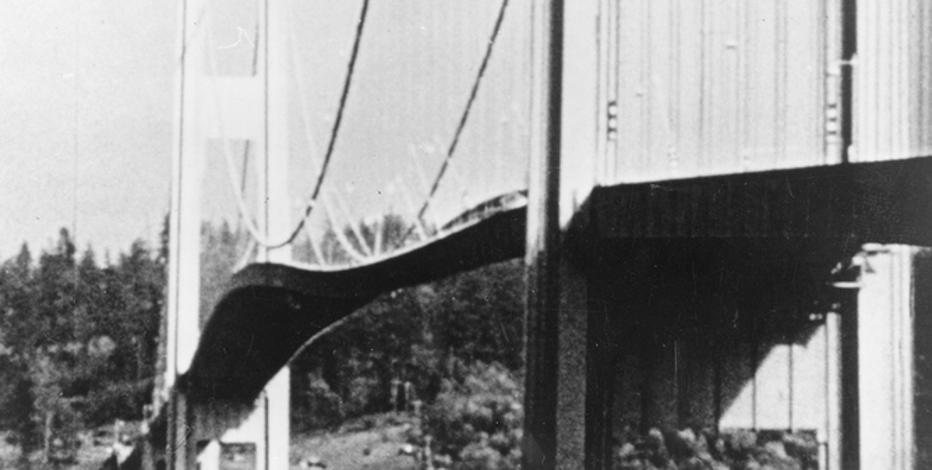
Tacoma Narrows Bridge: 'Galloping Gertie' collapsed 85 years ago
On Nov. 7, 1940, the Tacoma Narrows Bridge, or ‘Galloping Gertie,’ dramatically collapsed into the Puget Sound. Friday marks 85 years since the disaster reshaped how engineers approach long-span bridges.
The disaster was a landmark event in civil engineering history and brought global attention to the city. The rebuilt bridge opened in 1950.
During World War II, the city's industries were crucial to the war effort.
Shipbuilding, lumber production and heavy manufacturing boomed, supporting the nearby Fort Lewis, now known as Joint Base Lewis-McChord, or JBLM.
Decline, stagnation, shifting identity
The mid-century was marked by industrial decline and social challenges that led to one of Tacoma's reputations for being "sketchy."
Global economic shifts and environmental awareness led to the closure or scaling back of major industrial employers, particularly in timber and smelting. This led to a significant loss of jobs and a tax base, contributing to urban decay.
The economic stagnation contributed to a rise in crime and social issues in the downtown core and neighborhoods like Hilltop, which negatively impacted the city's public image.
The infamous ASARCO Smelter finally closed in 1986, ending the primary source of metallic contamination but leaving behind the massive environmental cleanup challenge known as the Tacoma Smelter Plume Superfund site.
Modern Tacoma
The late 20th and early 21st centuries have been defined by intentional efforts to revitalize the urban core, focusing on arts, education and culture.
The University of Washington Tacoma campus was established in historic buildings in 1990 and the opening of the iconic Museum of Glass and the Chihuly Bridge of Glass were opened in 2002.
Today, Tacoma continues its renewal as a major center for the Port of Tacoma, education, healthcare and culture, successfully pivoting away from its heavy industrial past to become a diverse and vibrant regional city.
Happy birthday, Tacoma.
The Source: Information in this story came from the National Trust for Historical Protection, Tacoma Public Library, the Digital Public Library of America, HistoryLink and original FOX 13 Seattle reporting.
MORE NEWS FROM FOX 13 SEATTLE
WA baby hospitalized with botulism, leading to baby formula recall
Lenny Wilkens, legendary Seattle SuperSonics player and coach, dies at 88
Seattle to update street parking rates again — see what’s going up
Rad Power Bikes faces permanent closure at Seattle site
Seattle's SODO housing ordinance blocked after Port of Seattle wins lawsuit
To get the best local news, weather and sports in Seattle for free, sign up for the daily FOX Seattle Newsletter.
Download the free FOX LOCAL app for mobile in the Apple App Store or Google Play Store for live Seattle news, top stories, weather updates and more local and national news.