

Tacoma Narrows Bridge: 'Galloping Gertie' collapsed 85 years ago
TACOMA - What was initially built as a symbol of modern design with a state-of-the-art engineering reputation, quickly became one of the most famous and studied engineering disasters in history.
On Nov. 7, 1940, the Tacoma Narrows Bridge, famously known as ‘Galloping Gertie,’ dramatically collapsed into the Puget Sound. Friday marks 85 years since the disaster reshaped how engineers approach long-span bridges.
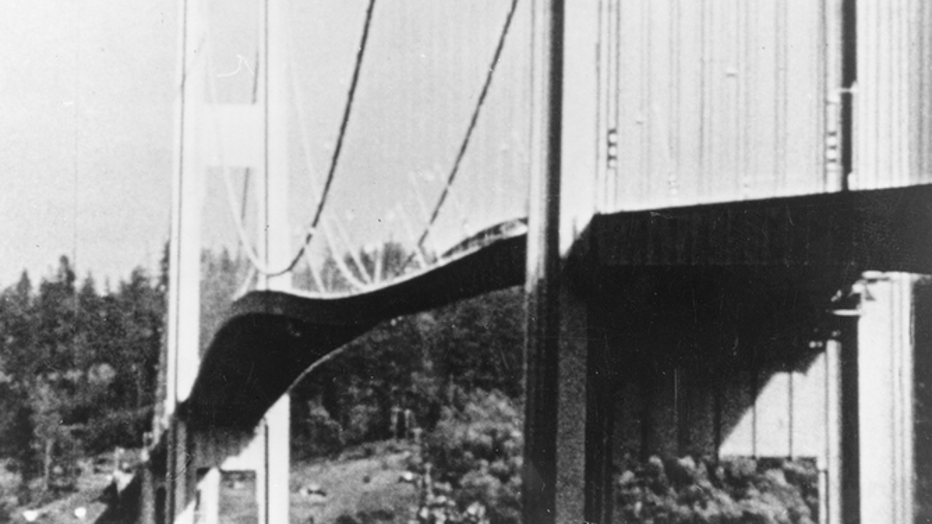
7th November 1940: Tacoma Narrows suspension bridge, in Puget Sound, Washington, vibrating violently just prior to its collapse due to strong winds causing a violent oscillating motion known as 'flutter' (Keystone/Getty Images)
The backstory:
The bridge was considered a masterpiece of "modernist" bridge design, an extreme example of the era's trend toward slenderness and grace.
Designed by Leon Moisseiff, the bridge was intended to be the ultimate expression of the lighter, more affordable and more flexible suspension bridge model, than the Golden Gate Bridge, according to WSDOT.
Moisseiff served as a highly respected consulting engineer on the Golden Gate Bridge project in 1937.
He was instrumental in providing the advanced theoretical basis for its design, which was one of the first to apply his "Deflection Theory." This theory championed lighter, more flexible suspension spans.
Essentially, the Tacoma Narrows Bridge was built upon the same design philosophy (Moisseiff's Deflection Theory) that made the Golden Gate Bridge possible, only it pushed the limits of that theory much further—to a point that proved fatally unstable.
What led up to the collapse?
Timeline:
Along the lines of the design, Moisseiff utilized solid, deep plate girders (which are the large, main horizontal beams that support the weight of the bridge), rather than the traditional, open-web lattice trusses used in successful suspension bridge projects, according to WSDOT.
The consequence of this structure was rooted in the inability for wind to pass through. When wind could not pass through, the deck began to act as a sort of airplane wing; it would catch wind and generate an unstable twisting movement.
The bridge opened on July 1, 1940, and was immediately admired by the public. However, within weeks of operation, the bridge began to exhibit noticeable vertical, wave-like movements.
These movements almost immediately earned the bridge its famous "Galloping Gertie" title. While many people found the movements uncomfortable and terrifying, others found it exhilarating and joyriders drove onto the bridge just to feel the movement.
A few months in, University of Washington Professor F.B. Farquharson and others were brought in to study the problem.
They attempted anchoring the main cables to the bridge approaches, tried using hydraulic dampers, which are similar to giant shock absorbers.
What was the root cause of the collapse?
Four months later, the bridge started vibrating violently due to strong winds and eventually collapsed dramatically.
The root cause was later determined to be aeroelastic flutter, which is a self-exciting and unbounded motion where the twisting of the bridge changed the airflow around the bridge.
In turn, this reinforced the twisting motion, creating a feedback loop until the structure tore itself apart.
Were there any fatalities?
By the numbers:
There were no human lives lost, but one of the most memorable elements of this engineering tragedy was the loss of a dog named Tubby, a three-legged dog trapped inside of one of the abandoned cars. Tubby's owner was a copy editor at the Tacoma News Tribune.
What happened after the collapse?
Moisseiff's reputation was significantly tarnished by the collapse, and he died of a heart attack three years later.
The first permanent replacement bridge was built less than a decade after the collapse. It currently carries westbound traffic from Tacoma to Gig Harbor.
Between the collapse in 1940 and the construction of the replacement bridge which debuted in 1950, travelers, including commuters and vital military traffic, took detours to get from Tacoma to the Kitsap Peninsula.
Due to massive traffic growth, a second, parallel span was built in the early 2000s to serve as the second half of the crossing. Today, it carries eastbound traffic from Gig Harbor to Tacoma.
The Source: Information in this story came from original FOX 13 reporting, WSDOT, History Link and Live Science.
MORE NEWS FROM FOX 13 SEATTLE
LIVE: WA state election results 2025
Police pursuit ends in deadly motorcycle crash in Lakewood, WA
Seattle Sounders' Cristian Roldan named to 2025 MLS Best XI
When do election results get updated in WA?
Bruce Harrell leads Katie Wilson in race for Seattle mayor
Everett, WA woman hospitalized amid national listeria outbreak
WA election results: Tracking a close race for King County Executive
To get the best local news, weather and sports in Seattle for free, sign up for the daily FOX Seattle Newsletter.
Download the free FOX LOCAL app for mobile in the Apple App Store or Google Play Store for live Seattle news, top stories, weather updates and more local and national news.